India-Pakistan Geopolitical Map Reveals Shifting Alliances
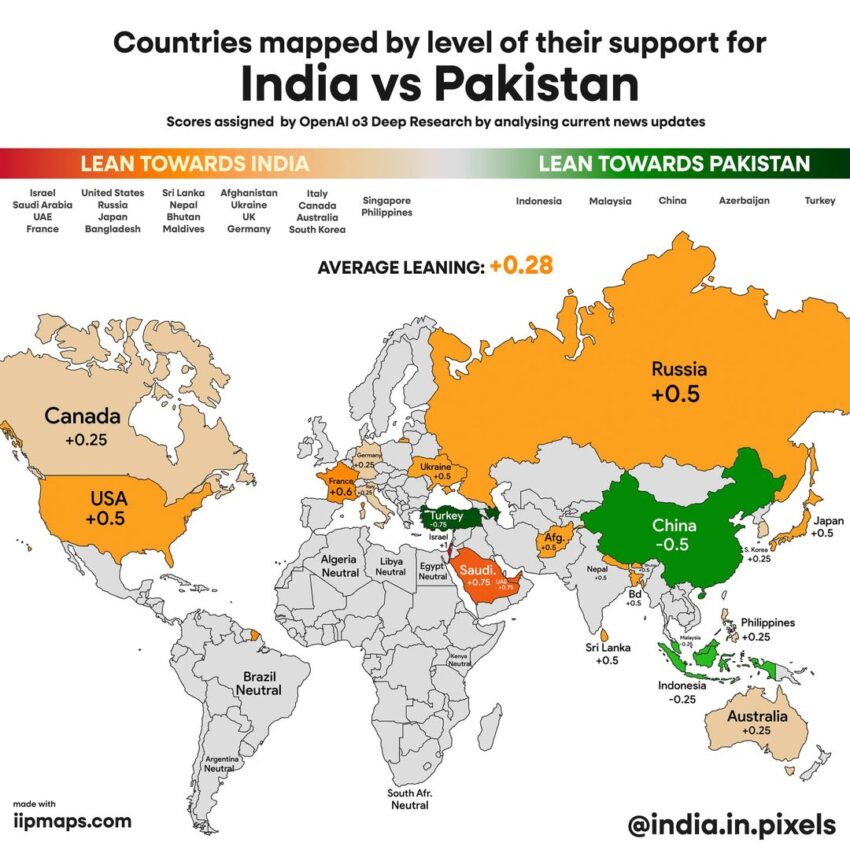
**A new geopolitical map unveiled by India in Pixels on May 8, 2025, titled ‘Countries Mapped by Level of Their Support for India vs. Pakistan,’ has ignited crucial discussions surrounding the evolving alliances in South Asia. The map, which leverages scores provided by OpenAI’s O3 Deep Research through extensive analysis of current news updates, reveals a surprising pro-India tilt among several nations. Notably, Saudi Arabia, Bangladesh, and the UAE exhibit strong support for India with scores of +0.75, +0.5, and +0.75 respectively. This marks a significant shift from past alliances, especially as Pakistan has historically relied on these countries for support.
The findings indicate an average global lean of +0.28 toward India, illustrating a marked change in international sentiment. In particular, Saudi Arabia and the UAE, once viewed as steadfast allies of Pakistan due to shared religious and economic ties, appear to be reassessing their positions. Analysts attribute this change to recent developments, including the substantial economic partnership between Saudi Arabia and India, where bilateral trade reached an impressive $52 billion in 2024.
Saudi Arabia and UAE Strengthen Ties with India
As India emerges as a crucial market for Saudi oil and a key partner in the Vision 2030 initiatives, the relationship has deepened considerably. Similarly, the UAE has bolstered its connection with India through significant investments in technology and infrastructure, highlighted by a landmark $2 billion deal in 2024 aimed at developing AI hubs in Bangalore. These developments suggest a pronounced shift in regional dynamics that could reshape alliances in the coming years.
Moreover, Bangladesh’s alignment with India comes as less of a surprise, particularly considering the ongoing tensions with Pakistan since the 1971 Liberation War. Recent collaboration on counterterrorism efforts and trade further emphasizes this shift, with relations between Dhaka and Islamabad growing increasingly strained over border security issues. A political analyst from Dhaka noted, “Bangladesh views India as a stabilizing presence in the region, especially given Pakistan’s internal challenges and its prioritization of military expenditure over developmental needs.”
Broader Trends in Global Alliances
The map also highlights broader global trends, revealing that the USA (+0.5), Canada (+0.25), and Japan (+0.5) demonstrate a similar pro-India inclination. This trend reflects strategic partnerships that seek to counterbalance China’s growing influence in the Indo-Pacific region. In stark contrast, China (-0.5) and Turkey (-0.75) have shown a clear leaning towards Pakistan, reinforcing historical and military relationships.
Notably, Russia’s slight inclination toward India (+0.5) is significant, given its long-standing arms trade ties with New Delhi, despite maintaining relations with Islamabad. This complex web of alliances illustrates the intricate nature of global geopolitics in the region, claiming that Pakistan faces mounting challenges in the wake of shifting allegiances.
A Reconsideration of Strategic Realignments

While the map may suggest a growing tilt toward India among traditional partners of Pakistan, such an interpretation may overlook the qualitative dimensions of Pakistan’s emerging alliances. Unlike India’s recent diplomatic wins—largely grounded in economic and trade-related incentives—Pakistan’s realignment reflects a more strategic depth, particularly in the realm of defense cooperation.
The increasing defense ties with Turkey, a country that has rapidly advanced its indigenous defense industry, signal more than a mere supplier-client relationship. Turkish military exports, especially in drone and aerospace technology, have begun to shape new defense dynamics in South Asia. Moreover, Pakistan’s discreet yet consistent collaboration with China on next-generation aircraft and integrated defense systems hints at a long-term vision that transcends the current political optics.
While India garners symbolic support from the Gulf and regional actors—often driven by trade, investment, and diaspora politics—Pakistan’s partnerships are evolving around hard power capabilities and self-reliant defense modernization. In this light, the narrative of isolation may be premature. The emerging security architecture, fueled by Pakistan’s access to cutting-edge military technologies from Ankara and Beijing, could eventually offer strategic advantages that are not immediately visible on a diplomatic map but carry weight in long-term regional calculus.